

Digital Marketing for Dentists: Your Growth Playbook
The days of relying on location and word of mouth to fill an appointment book are over. To thrive in the competitive UK dental market, a proactive plan to attract new patients is essential. This requires a shift in mindset: marketing is not an expense; it is the engine that drives a practice forward.
Digital marketing is the use of online channels to attract, engage, and retain patients. It involves replacing outdated methods with a modern system built on search engine visibility, targeted advertising, and valuable content to grow your practice.
The Modern Blueprint for Dental Practice Growth
Success today is not accidental. It is the result of a deliberate, multi channel strategy that places your practice in front of people searching for your services.
Today’s top performing practices use a strategic mix of SEO, paid advertising, and reputation management to build relationships and attract high value patients.
Building an Integrated Patient Acquisition Engine
A winning strategy is not about choosing one online channel and hoping for the best. It is about weaving several key components together so they function as a cohesive system. Each piece has a specific role, guiding a potential patient from their initial Google search to booking their first appointment.
This infographic breaks down the core pillars that support sustainable growth for a dental practice.
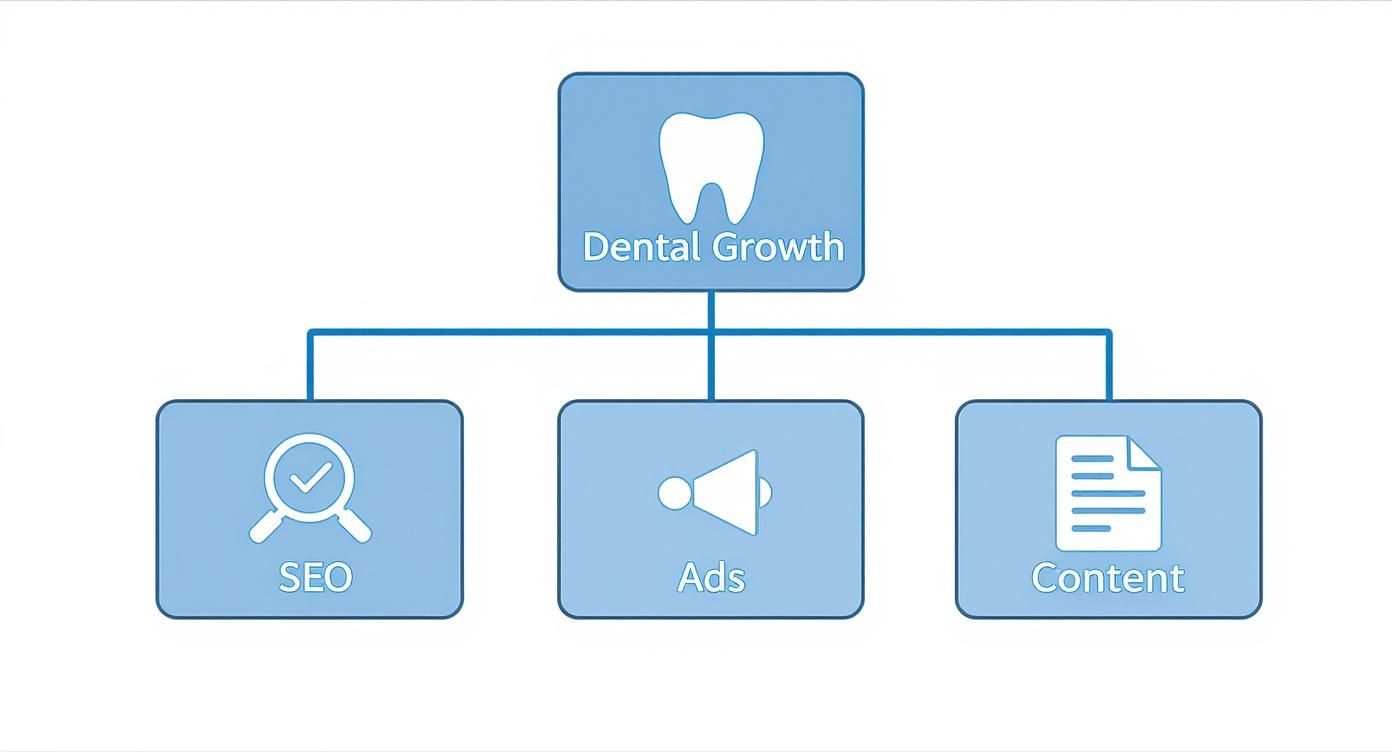
As shown, SEO, paid ads, and content marketing are not standalone activities. They are interconnected branches that support the same trunk: your practice’s growth. Each one addresses a different stage of a patient’s journey, creating a solid system for attracting and converting new enquiries.
To gain a clear picture of how these elements fit together, here is a breakdown of what a modern dental marketing strategy entails.
Core Components of a Modern Dental Marketing Strategy
| Marketing Pillar | Primary Objective | Key Metric |
|---|---|---|
| Website & Local SEO | Build long term visibility and trust in local search | Google ranking, Map Pack visibility |
| Paid Search & Social Ads | Generate immediate, targeted patient leads | Cost per lead, conversion rate |
| Content & Social Media | Educate patients, build community and authority | Engagement rate, website traffic |
| Reputation Management | Establish credibility through patient reviews | Number of reviews, average star rating |
| CRM & Lead Follow-up | Convert enquiries into booked appointments | Lead to patient conversion rate |
| Measurement & Analytics | Track ROI and optimise marketing spend | Return on investment (ROI) |
This table shows that each pillar has a distinct goal and a method for measuring success, ensuring every part of your marketing is accountable and effective.
Consider your marketing plan as a well organised clinical team. SEO is your foundation, building your long term reputation. Paid ads are your emergency appointments, bringing in immediate opportunities. Content marketing is your patient care coordinator, nurturing relationships with the community. When they all work in unison, the result is predictable, sustainable growth.
This integrated approach ensures your practice is visible, credible, and engaging at every touchpoint. It transforms your online presence from a simple digital brochure into a powerful, automated system for filling your appointment book and building a thriving, profitable practice.
Building Your Digital Foundation with a High-Performing Website
Your website is the digital front door to your practice. It is often the first interaction a potential patient has with you, making it the single most important asset in your marketing strategy. A slow, confusing, or outdated website can deter new patients before they even consider your services.
Conversely, a high performing website acts as your best receptionist, working 24/7 to attract, inform, and convert visitors into booked appointments. It is the central hub where all your marketing efforts, from Google searches to social media posts, ultimately lead.
Designing a Patient-Centric Website Experience
An effective dental website is built entirely around the patient. This means creating an experience that is intuitive, reassuring, and effortless to navigate, especially for someone who may be anxious about dental treatment. Your goal is to answer their questions quickly and guide them smoothly toward taking the next step.
Here are the key elements of a patient centric design:
- Mobile First Design: Most patients will find your practice on their smartphone. Your website must provide a flawless experience on smaller screens, with easy to tap buttons and text that does not require zooming.
- Clear Calls to Action (CTAs): Every page should have a clear, prominent button like “Book an Appointment” or “Call Us Now.” This removes guesswork for the visitor.
- Simple Navigation: Your services, team information, and contact details should be one click away from the homepage. A confusing menu is a primary reason visitors abandon a site.
- Authentic Imagery: Avoid generic stock photos. Using high quality photos and videos of your actual practice, team, and smiling patients builds trust more effectively.
These components work together to build a patient’s confidence and make the process of choosing your practice a simple, positive one. To see how these principles are applied in practice, view our portfolio of high converting dental website designs.
Securing Your Prime Digital Real Estate with Local SEO
Once your website is in place, you need to ensure local patients can find it. This is the function of Local Search Engine Optimisation (SEO). It is the digital equivalent of securing the best storefront on the busiest high street.
When someone in your area searches “dentist near me” or “emergency dental care,” you want your practice to appear at the top of the results. This prime visibility is achieved through a specific set of optimisation techniques focused on your geographical area.
The most coveted spot in local search is the Google “Map Pack,” the box showing a map and the top three local business listings. Appearing here dramatically increases your visibility, calls, and direction requests because it is the first thing most searchers see.
A strong Local SEO strategy is not about tricking search engines. It is about providing clear, consistent, and authoritative signals that establish your practice as the most relevant and trustworthy choice for local patients.
Mastering Your Google Business Profile
Your Google Business Profile (GBP) is the cornerstone of your Local SEO success. It is the free profile that appears in Google Maps and local search results, containing your practice’s name, address, phone number, hours, and patient reviews. An incomplete or inaccurate GBP is a significant deterrent to both Google and potential patients.
Optimising your profile is a critical first step. This involves:
- Claiming and Verifying Your Listing: Ensure you have full control over the information displayed about your practice.
- Ensuring NAP Consistency: Your Name, Address, and Phone number must be identical across your website and all other online directories. Consistency is crucial.
- Selecting Accurate Categories: Choose primary and secondary categories that precisely match the services you offer, such as “Dentist,” “Cosmetic Dentist,” or “Dental Implants Provider.”
- Uploading High Quality Photos: Regularly add photos of your clinic’s interior, exterior, team, and equipment to give patients a virtual tour.
This profile acts as a digital snapshot of your practice. A well managed GBP gives Google the confidence to rank you highly and provides patients with the information they need to choose you over a competitor.
Attracting High-Value Patients with Targeted Paid Advertising
While a strong website and Local SEO build long term authority, sometimes you need the phone to ring now. This is where paid advertising, particularly Pay Per Click (PPC) campaigns on platforms like Google Ads, becomes a game changer for immediate growth.
Think of it this way: SEO is like planting an orchard that will bear fruit for years, but PPC is like having a stall at the local market, putting your best produce directly in front of buyers today. When a potential patient searches for “dental implants in Manchester” or “emergency dentist near me,” a well executed PPC campaign places your practice at the top of the search results, capturing their attention before they see the organic listings.
This is not just about getting more traffic; it is about strategically filling your appointment book with the specific, high value cases you desire.
Mastering the Language of Paid Search
To know if your ad campaigns are performing, you must become familiar with a few key metrics. These metrics go beyond simply counting clicks; they provide a clear picture of your campaign’s financial performance and efficiency. Understanding these is crucial for making informed decisions and optimising your ad spend.
Here are the core metrics every practice owner should monitor:
- Cost Per Click (CPC): This is the amount you pay each time someone clicks on your ad. It can fluctuate based on the competitiveness of your chosen keywords.
- Cost Per Lead (CPL): This is the total cost to generate one qualified patient enquiry, whether a phone call or a submitted website form.
- Conversion Rate: This is the percentage of people who click your ad and then take the desired action, such as booking an appointment. It directly measures how well your ad and landing page are working together.
Understanding these figures helps you see the true return on your investment. A low CPC is beneficial, but a low CPL signals a profitable campaign. It shows you are not just buying clicks but efficiently acquiring new patients.
Our team focuses on building and managing campaigns that deliver a strong return. You can see how we drive results by exploring our approach to Google PPC ads for dentists.
Strategic Keyword and Ad Copy Development
The success of any PPC campaign depends on two things: choosing the right keywords and writing compelling ad copy. Your keywords are the trigger; they decide when your ad appears. Your ad copy is your first impression; it must convince someone to choose you over other practices on the page.
Smart keyword selection means focusing on “high intent” phrases that indicate a person is ready to book. Broad terms like “dentist” are not only expensive but also attract users who are only browsing. Instead, be specific with service related keywords, such as:
- “Invisalign cost London”
- “Best cosmetic dentist for veneers”
- “Same day dental implants”
This precise targeting connects you with patients who have a clear need and are further along in their decision making process. Once you have their attention, your ad copy must quickly communicate your value. Highlight key benefits like flexible financing, advanced technology, or a free consultation to provide a compelling reason to click.
Paid advertising is not about attracting everyone; it is about attracting the right patients. By targeting keywords for high value treatments, you ensure your marketing budget is spent attracting the most profitable cases, directly contributing to your practice’s bottom line.
This is a competitive but valuable space. Industry benchmarks show the average click through rate (CTR) for dental ads in the UK is 5.44%, with a cost per click (CPC) of around £5.80. With an average conversion rate of 9.08%, this translates to a cost per lead of approximately £62.01, reflecting the investment required to secure these valuable new patients.
Comparing Patient Acquisition Channels
When allocating your marketing budget, it is helpful to compare the two main digital channels: Local SEO and Google Ads (PPC). Each has its own strengths and plays a different role in a comprehensive strategy.
| Attribute | Local SEO | Google Ads (PPC) |
|---|---|---|
| Speed | Slow and steady; results build over 6 to 12 months | Immediate; can generate leads within days or hours |
| Cost | Ongoing investment in content and technical work | Pay per click model, direct ad spend required |
| Long Term Value | Creates a lasting digital asset that grows over time | Stops as soon as you stop paying |
In summary, Google Ads is your accelerator for acquiring new patients quickly, while Local SEO is the engine you build for sustainable, long term growth. Most successful practices find that a blend of both delivers the best overall results.
Building Community Trust Through Content and Social Media
While targeted ads and local SEO are excellent for generating immediate enquiries, a truly resilient practice is built on a foundation of trust. This is where content and social media are vital. Consider them your primary tools for transforming your practice from just another local service into a valued community health resource.
The objective is to build relationships long before someone needs an appointment. You want to be the resource people turn to with questions or anxieties about their dental health. When you consistently provide that value, you naturally become the first practice they call when they need care. This long term strategy complements your patient acquisition efforts by creating a loyal following that sees you as the dental authority in your area.
Developing an Educational Content Strategy
Your content should be a digital extension of your chairside manner: reassuring, informative, and always focused on the patient. By creating resources that address common concerns, you demystify dentistry and empower people to take better care of their teeth. It functions as a pre consultation, building confidence in your expertise before they walk through the door.
This approach positions your practice as a caring expert, not just a business selling treatments. The key is to create genuinely helpful content that answers the questions potential patients are typing into Google.
Here are a few practical ideas to get you started:
- Blog Posts: Write detailed but simple articles explaining procedures. Consider titles like, “What to Expect During Your First Dental Implant Consultation” or “The Differences Between Veneers and Composite Bonding.”
- Patient Friendly Videos: Film short, welcoming videos to introduce your team, provide a tour of the practice, or explain how a piece of technology works. Video is incredibly effective at easing patient anxiety.
- Downloadable Guides: Offer useful resources like a “Guide to Your Child’s First Dental Visit” or a “Checklist for Managing Dental Anxiety.” You can offer these in exchange for an email address to build your contact list.
This is not just about filling your website. Every piece of content is a powerful SEO asset, helping you rank for more specific search terms and attracting visitors who are actively seeking information.
Leveraging Social Media for Community Engagement
Platforms like Facebook and Instagram offer an opportunity to show the human side of your practice. While professional, educational content has its place, these channels are most effective when they reflect your practice’s unique personality and build a genuine connection with your followers. This is where you transition from a clinic to a familiar, trusted part of the community.
Your social media feed should be a mix of helpful tips, practice news, and behind the scenes moments. This variety keeps your audience engaged and ensures you are the first name that comes to mind when a dental issue arises.
Your social media should not be a constant advertisement. Instead, treat it like a local community noticeboard where you share helpful advice, celebrate patient successes, and introduce the friendly faces behind the scrubs. This approach builds relationships, not just patient lists.
Curating a Compelling Social Media Presence
To build a social media presence that resonates with local people, focus on content that feels authentic, relatable, and professional. Consistency is also vital; posting several times a week is the best way to remain visible in your followers’ feeds.
Try incorporating some of these content ideas:
- Introduce Your Team: Post short biographies or video interviews with your hygienists, assistants, and front desk staff. It puts a friendly, human face to the practice name.
- Share Patient Success Stories: With their full permission, feature before and after photos or a short testimonial from a happy patient. These stories are powerful social proof.
- Run Q&A Sessions: Host a live Q&A on Facebook or Instagram where you answer common dental questions submitted by your followers. It is a great way to engage directly with your audience.
- Celebrate Community Events: Share photos of your team participating in local charity runs, school events, or community fairs. Show that you are an active part of the neighbourhood.
By weaving together educational content with authentic social media engagement, your practice can build a strong foundation of community trust. It is a critical piece of the puzzle, ensuring not just immediate growth but long term loyalty and recognition.
Mastering Your Online Reputation to Build Patient Confidence
In the current digital landscape, your practice’s reputation is built as much online as it is in your community. Before a potential patient considers your clinical skills, they will almost certainly research you online. What they find, especially your patient reviews, will significantly influence their decision to book an appointment.
Think of online reviews as the new word of mouth referral, but with far greater power and visibility. A steady flow of positive feedback on platforms like Google is powerful social proof. It tells prospective patients they will be in safe, capable hands. This feedback is a non negotiable asset for any dental marketing strategy.
Managing your reputation is not a passive activity; it demands a proactive and professional approach. It is about more than just collecting five star ratings. This is a continuous process of building a transparent, trustworthy brand that gives new patients the confidence they need to choose you over a competing practice.
Proactively Encouraging Patient Feedback
The most straightforward way to build a strong collection of positive reviews is to ask for them.
A happy patient might intend to leave a positive review, but life often intervenes, and they forget once they leave your practice. Implementing a simple, automated system to request reviews can make a significant difference.
The key is to make the process completely seamless for the patient. A well timed email or text message sent shortly after their appointment, with a direct link to your Google Business Profile, removes all friction. It makes it incredibly easy for them to share their positive experience in just a few clicks.
A strong online reputation has a direct impact on your bottom line. Practices that actively manage their reviews often see higher conversion rates from their website and ad campaigns because positive feedback validates their marketing claims.
By making it easy for satisfied patients to share their stories, you create a cycle of positive reinforcement that strengthens your brand and attracts more of the patients you want.
Responding to All Reviews Professionally
How you respond to reviews is just as important as receiving them. Your replies are public, demonstrating your practice’s commitment to patient care and satisfaction. Responding to every review, both positive and negative, is essential for building public trust.
For positive reviews, a personalised thank you shows you appreciate their time and reinforces their good experience. Avoid generic, copy and paste replies. Instead, mention a small detail from their feedback to show you are genuinely listening.
When it comes to negative reviews, your approach is even more critical.
- Respond Promptly and Professionally: Acknowledge their concerns without becoming defensive.
- Show Empathy: Express regret that their experience did not meet their expectations.
- Take the Conversation Offline: Offer to resolve the issue directly by phone or email. This protects patient privacy and shows you are committed to finding a solution.
Handling criticism professionally shows potential patients that you take feedback seriously and are dedicated to providing the best possible care. This is a crucial element in turning online reputation into real world patient retention. For a deeper look at this connection, you can learn more about transforming your reputation into patient retention in our detailed guide.
Capitalising on the UK Private Dentistry Boom
A significant shift is occurring in UK dentistry, creating a major opportunity for private practices. With mounting pressure on NHS services, more patients than ever are seeking private care, many for the first time. This has opened up a new, motivated patient base that is ready to invest in their oral health.
For any forward thinking practice owner, this is a moment that cannot be missed. The strategies covered in this guide, from a high performing website and effective local SEO to targeted ads and solid reputation management, are precisely what you need to connect with this growing market. It is no longer enough to just offer private treatments; you must be visible when and where patients are searching for them.
The Growing Demand for Private Dental Care
The difficulty in securing an NHS dental appointment has become the main driver of this change. A recent survey revealed a stark picture: 82.8% of English dental practices were not accepting new adult NHS patients, and 71.1% had closed their books to new child patients. This scarcity leads to long waits, forcing many, especially those with urgent needs or more disposable income, to seek reliable, timely care in the private sector. You can get a fuller picture of the market from the latest UK dental trends and insights from Dentistry Today.
This is not just a fleeting trend; it is a fundamental change in how people are approaching their dental care. It is a clear opportunity for private practices to showcase what they can offer, whether that is shorter waiting times, advanced technology, or a more personal, patient focused experience.
Your digital marketing is the bridge connecting your practice to this new wave of patients. It ensures that when someone decides to go private, your practice is the first and most trusted name they find.
Creating a Cohesive Growth Strategy
To fully seize this opportunity, all your marketing efforts must work together. A great website builds credibility. Local SEO ensures you appear in “dentist near me” searches. Paid ads allow you to reach patients looking for high value treatments like implants or orthodontics right now. And a series of positive online reviews provides the social proof that helps people make their final decision.
When you integrate all these elements, you create a powerful system for attracting new patients. This cohesive approach will help your practice not just survive but thrive in the current market, cementing your position as a leading private dental provider in your community.
Your Top Dental Marketing Questions Answered
When dentists begin exploring digital marketing, a few key questions consistently arise. How much should I spend? When will I see results? Where should I allocate my budget for the best return? Answering these questions correctly is the first step toward building a marketing plan that predictably and consistently brings new patients through the door.
Let’s break down some of the most common queries from practice owners.
How Much Should a Dental Practice Budget for Marketing?
A general guideline is to allocate 7% to 12% of your total practice revenue for marketing. For a newer practice establishing its brand, or a practice in a competitive city aiming for aggressive growth, you might need to allocate closer to 15%. This should be viewed as a direct investment in your practice’s growth, not merely an expense.
It is also important to remember this budget is not just for running ads. A solid marketing budget covers all necessary components for success, including:
- Website Maintenance and Hosting: Keeping your digital front door open, secure, and functioning flawlessly.
- SEO and Content Creation: The long term effort required to build your authority and appear on Google organically.
- Paid Advertising Spend: The direct cost of your campaigns on platforms like Google and Facebook.
- Agency or Team Costs: The expertise required to manage, optimise, and maximise the return from your strategy.
How Long Until Dental SEO Shows Results?
Search Engine Optimisation is a long term strategy. While you may see some encouraging signs within three to six months, such as moving up a few positions in Google, it typically takes six to twelve months to see a tangible impact on your new patient numbers. This is because SEO is about building trust and authority with search engines, which does not happen overnight.
Several factors can affect this timeline, such as the level of competition in your area, the current health of your website, and the consistency of your SEO efforts. Patience is essential. The payoff is a steady stream of high quality organic leads, which often delivers the best long term return on investment.
Which Channel Has the Best Return on Investment?
The “best” channel depends entirely on your immediate goals.
If you need to generate immediate enquiries for high value treatments like dental implants or Invisalign, Google Ads (PPC) is almost always the most effective choice. It places you directly in front of people who are actively searching for the exact services you offer. The return is fast and easy to measure.
However, for sustainable growth with the lowest patient acquisition cost over time, Local SEO is unbeatable. Once you secure top positions in the search results, you receive a consistent flow of clicks and calls without paying for each one.
For most practices, the ideal solution is a balanced strategy that uses both. PPC brings in immediate opportunities while SEO builds a powerful, long term asset for your practice.
Ready to build a predictable growth engine for your practice? At Connect My Marketing, we create bespoke digital marketing strategies that attract high value patients and deliver measurable results. Schedule your free discovery call today to find out how we can help you achieve your goals.


